Emerald Cut Diamond: Timeless Elegance & Modern Style Guide
luxury emerald cut diamond guide
Emerald Cut Diamond: The Timeless Shape With a Modern Edge
Still. Deliberate. The cut that rewards the second look every time.
People keep turning to the emerald cut diamond for a reason. Style trends do not stay put for long. Cuts come and go. Yet the emerald cut keeps showing up. It has long, rectangular lines with step facets. Those facets catch light in wide, steady swipes. The shine does not explode all over the place. It feels quiet instead. That calm look is what pulls some buyers back to it, again and again.
The emerald cut diamond traces back to the early 1900s. Around then, Art Deco was shifting how folks made both buildings and jewellery. This stone carries that shift in a direct way. You can see it in the clean edges and steady angles. The pattern looks set out on purpose, not made by chance. The scale and placement feel calm and balanced, like someone thought it through. There is also a sense that shape can be enough. The design does not rely on extra tricks to impress. Even as years pass, the look still holds. It does not feel stuck in the past. It also does not feel like it was forced to fit a trend. In the end, it reads as a simple fact. A diamond took on this style and kept it.
Emerald Cut Engagement Rings: Why This Shape Suits the Considered Buyer
Emerald cut engagement rings often appeal to a certain kind of buyer. They may not be rare in the market, and yes, famous names have worn them, but the real reason is simpler. This style asks for a calmer taste. You trade flash for depth. The round brilliant cut is loud in a good way. It sends light all over the stone. It grabs attention fast, before you even think about it. It feels like a quick announcement. An emerald cut diamond feels different. It does not shout. It pulls your focus inward, and you end up looking longer.
Emerald cut engagement rings have a practical benefit that people often learn after they buy. The step-cut facets tend to hide small scuffs better than some round cuts do. Since the facets are broader and flatter, minor marks are less obvious. The face of the stone also keeps a clean look, so it does not seem dull or messy after daily use. At Layla Diamonds, we point to this style for shoppers who want a ring they can wear a lot of without worrying about it all the time.
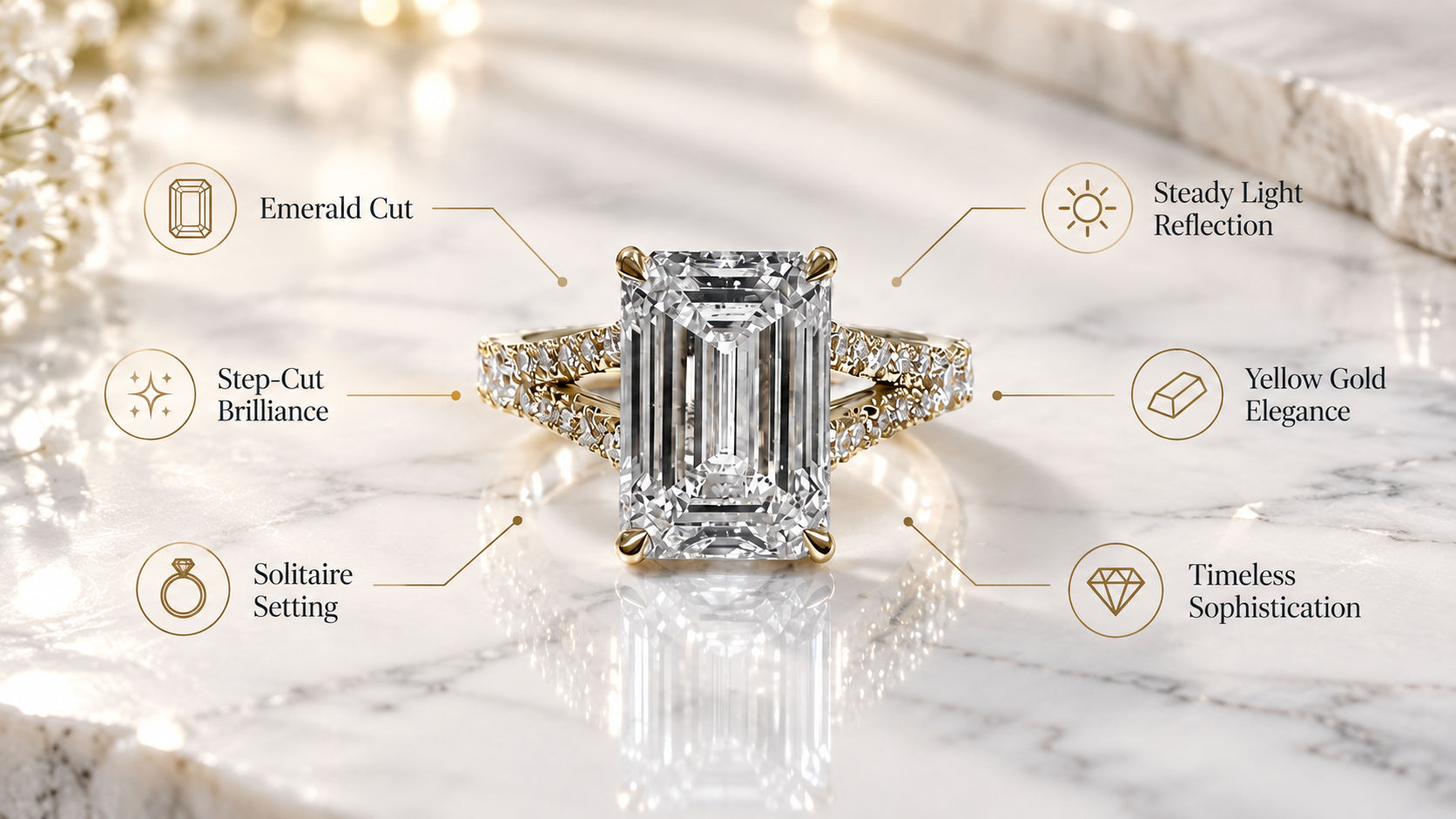
Emerald Cut Diamond Ring: What to Look for Before You Buy
An emerald cut diamond ring calls for extra care with clarity. This is the point to check before you buy. The emerald cut has an open, flat top. That "window" view makes the inside of the stone easier to see. Things that would blend in on a round brilliant can stand out in an emerald cut. Because of that, Layla Diamonds asks for VS2 clarity or higher. The goal is simple. The diamond should look clean when you look at it with your eyes.
Colour is the other variable worth understanding for an emerald cut diamond purchase. The step-cut facets retain colour more visibly than brilliant cuts; a stone that might look near-colourless in a round brilliant will show a warmer tint in the emerald cut. G or better is the general recommendation for platinum or white gold settings.
In yellow gold, an H or I colour can look beautiful; the warmth of the stone and the warmth of the metal become complementary rather than competing.
2 Carat Emerald Cut Diamond Ring: The Weight That Shows the Shape at Its Best
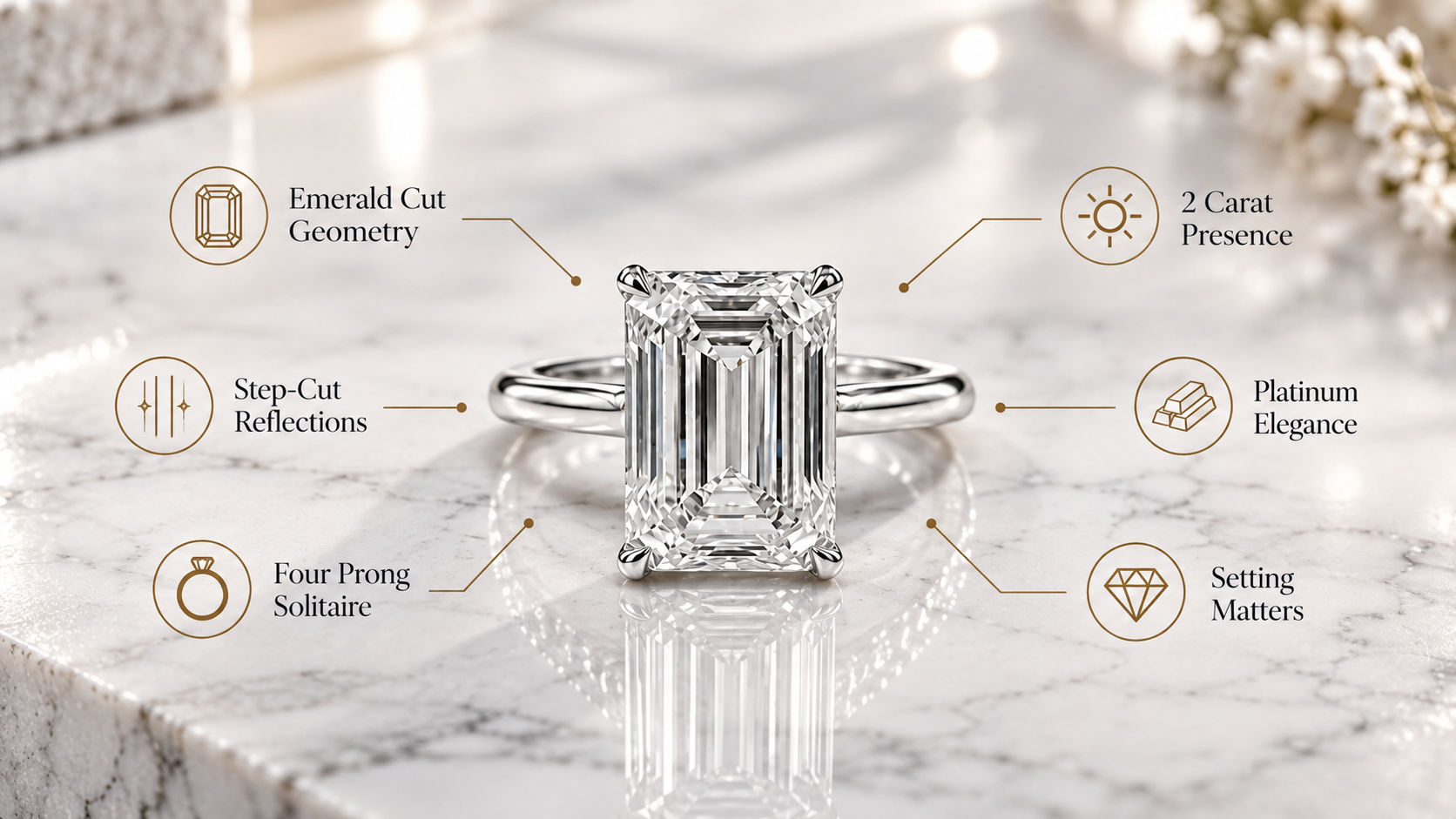
At one carat, the emerald cut diamond is elegant. At two, it becomes something else. A 2 carat emerald cut diamond ring has a face-up surface area that allows the step-cut facets to work fully, the broad reflections are wide enough to read clearly, the rectangular outline has real scale on the finger, and the stone's characteristic depth becomes genuinely hypnotic. The two-carat emerald cut is where the cut begins to show everything it is capable of.
At this size, you really notice clarity. If the table is wide, even small inclusions show up more. For a 2 carat emerald cut diamond ring, the table tends to be wide, so clarity matters. Layla Diamonds points to VS1 or VS2 for a good balance. They also look for a length-to-width ratio of about 1.40 to 1.50. This range helps the shape stay neat and not look too thin. It also keeps the stone looking tidy inside, not just on the surface.
Emerald Diamond Engagement Rings: Setting Choices That Honour the Cut
Emerald diamond engagement rings depend on the setting more than some other cuts. The gem's step-like facets have a clear pattern, and the setting can either match that look or break it. One popular choice is a four-prong solitaire. Put two prongs on the short ends and two on the long sides. This design leaves the stone very open. It also lets in a lot of light and keeps the outline from looking cut off. Another option is a bezel setting in yellow gold. This gives a cleaner, more built look to the ring.
Emerald diamond engagement rings in a halo setting are less common but striking when executed well. The key is proportion; the surrounding diamonds must be small enough to frame the emerald cut without visually competing with it. A halo that overwhelms the centre stone defeats the purpose of choosing the cut. At Layla Diamonds, we approach every emerald cut diamond setting as a collaboration between the stone's geometry and the setting's role: it should serve, never distract.
Lab Grown Diamond Rings: The Emerald Cut in Lab Grown Form
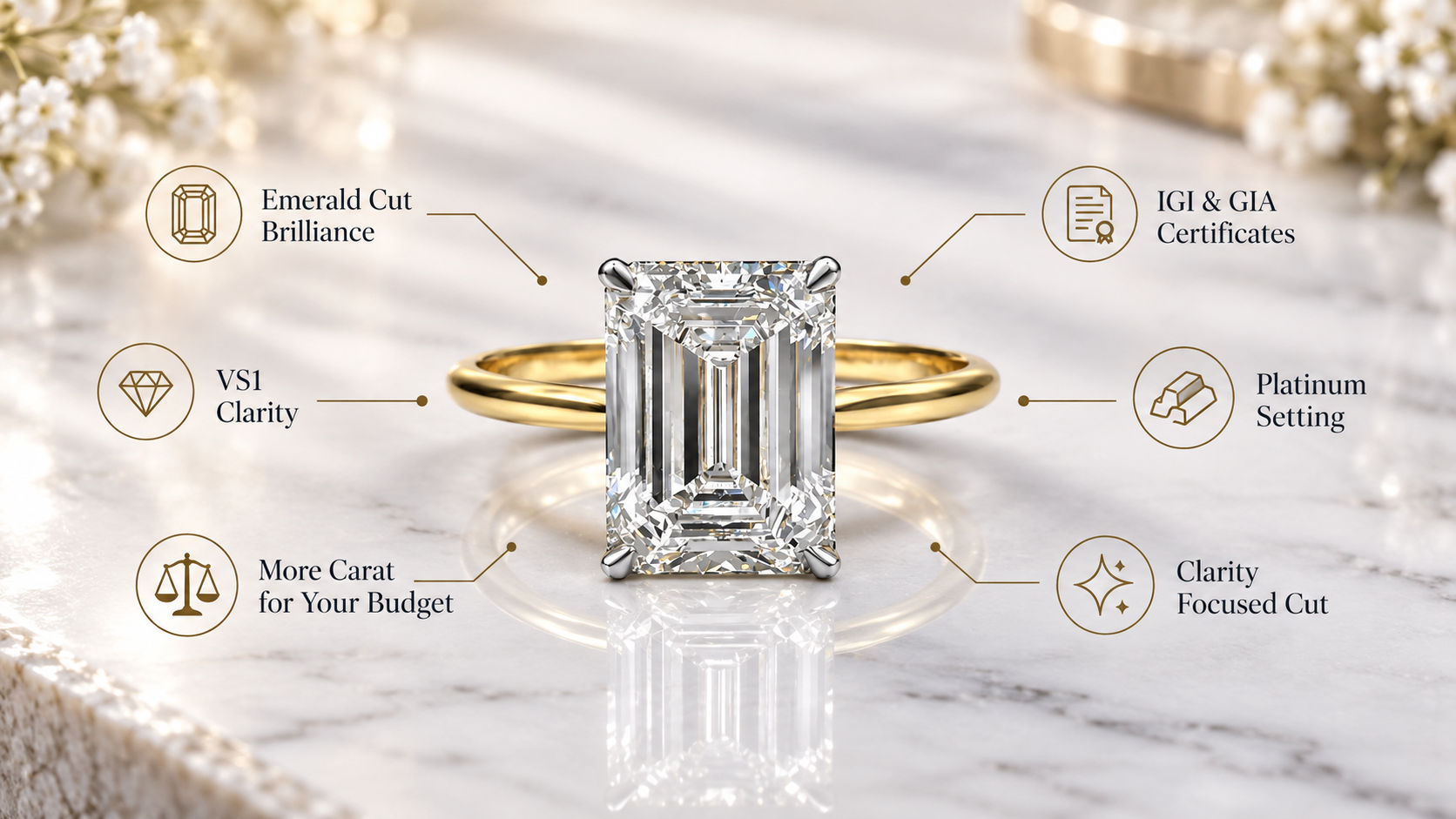
Lab grown diamond rings make a particularly compelling case in the emerald cut, and the reason is specific to the cut's requirements. Because the emerald cut demands high clarity, VS2 or better to look clean, and clarity grades drive price significantly in mined stones, the value advantage of lab grown diamonds is felt more acutely here than in almost any other cut. A lab grown emerald cut diamond at VS1 clarity is achievable at a budget that a mined stone of equivalent grade would put considerably out of reach.
Lab grown diamond rings are graded by the same independent laboratories, IGI and GIA, using identical criteria to mined stones. The certificate for a lab grown emerald cut reads exactly as the certificate for a mined one, because the stone is a diamond in every physical and optical sense. At Layla Diamonds, lab grown and mined stones are selected with equal rigour. The cut and the clarity are what determine quality. The origin determines the price.
Lab Grown Diamond Engagement Rings: Making the Emerald Cut Accessible
The practical implication of choosing lab grown diamond engagement rings in the emerald cut is significant. A budget that reaches one carat in a mined emerald cut diamond reaches two carats in lab grown form, and at two carats, the emerald cut becomes the version of itself that shows all of its qualities most fully. The broad reflections, the rectangular scale on the finger, and the particular depth of the step-cut interior. All of it becomes more present, more undeniable, at two carats.
At Layla Diamonds, our lab grown diamond engagement rings in the emerald cut are made with the same care as our mined diamond rings. We use the same metal finishing. We set the prongs with the same level of focus. We also check how the stone rests in the setting. It does not matter where the diamond began. The ring still has to meet the same standards. What does 'shift' mean? It is what you can do within your budget. With an emerald cut, clarity and size really show. That is why the change in budget can be a big deal.
The Cut That Has Always Been Ahead of Its Time
There is something unusual about the emerald cut diamond in the history of fine jewellery: it has never really had an era. It was not invented for the moment and then left behind when the moment passed. It arrived fully formed in the Art Deco period, suited that era perfectly, and then simply continued, equally at home in the mid-century, in the maximalist eighties, in the minimal nineties, and today. The reason is not versatility in the conventional sense. It is that the cut has a point of view, and points of view do not go out of fashion.
At Layla Diamonds, we believe the emerald cut diamond is the right choice for anyone who has looked at the full range and found that nothing else quite provides the particular quality this cut offers and that combination of depth, stillness, and geometric precision. It does not arrive quickly. It reveals itself. And for the right person, that quality is the entire point.
Choosing Your Emerald Cut Diamond
- Emerald cut engagement rings trade flash for depth. The step-cut facets pull focus inward, hide small daily scuffs better than round cuts, and keep the face of the stone looking clean after regular wear.
- An emerald cut diamond ring demands VS2 clarity or higher. The open flat top makes the inside of the stone visible in a way that a round brilliant would hide; the diamond should look clean to the naked eye.
- Colour matters more in an emerald cut than in a round brilliant. G or better for platinum or white gold settings; in yellow gold an H or I can look beautiful, warmth becoming complementary rather than competing.
- A 2 carat emerald cut diamond ring is where the cut shows everything it is capable of. Broad reflections wide enough to read clearly, a rectangular scale that has real presence on the finger, VS1 or VS2 clarity, length to width ratio 1.40 to 1.50.
- Emerald diamond engagement rings depend on setting more than most cuts. A four-prong solitaire leaves the stone open to light; a yellow gold bezel gives a cleaner, more built look; the setting must serve the stone's geometry, never distract from it.
- Lab grown diamond engagement rings in the emerald cut make the most compelling budget case of any format. Clarity grades drive mined stone prices high, and a lab grown emerald cut at VS1 is achievable at a budget a mined equivalent would put out of reach; a one-carat mined budget reaches two carats lab grown.
Discover the Beauty of an Emerald Cut Diamond in Person
At Layla Diamonds, every emerald cut diamond ring is designed around the stone. Book a private consultation at our London store because a cut this particular deserves to be seen in person before any decision is made.


Comments
Post a Comment