Lab Grown Diamonds: The Brilliant Science Behind Modern Sparkle
Luxury Lab Grown Diamonds Guide
Lab Grown Diamonds: Fascinating Facts Behind Modern Sparkle
The science is extraordinary. The stone is real. The rest is just detail.
Most conversations about lab grown diamonds begin with price, which is understandable. The value differential is typically fifty to seventy percent less than a mined diamond of equivalent quality, and that is significant enough to be the first thing anyone notices. But the story of how these stones exist at all is more interesting than the price tag. It involves centuries of failed attempts, two completely different scientific approaches, and a diamond seed the size of a pinhead. It also involves a stone that is, by every physical and chemical measure, a diamond.
People often say "synthetic diamonds", but lab grown diamonds are different from the usual meaning of that word. They are not cubic zirconia. They are also not glass. In a lab, carbon atoms are set up in the same crystal layout that you find in a mined diamond. The goal is to match the conditions that occur far below the surface in the earth's mantle. The result is a stone that acts like a diamond. That is because it is a diamond. Here are details about these stones that most people never hear. They also make choosing lab grown diamonds feel more engaging than what most conversations focus on.
Lab Grown Diamond Engagement Rings: The Science That Makes Them Possible
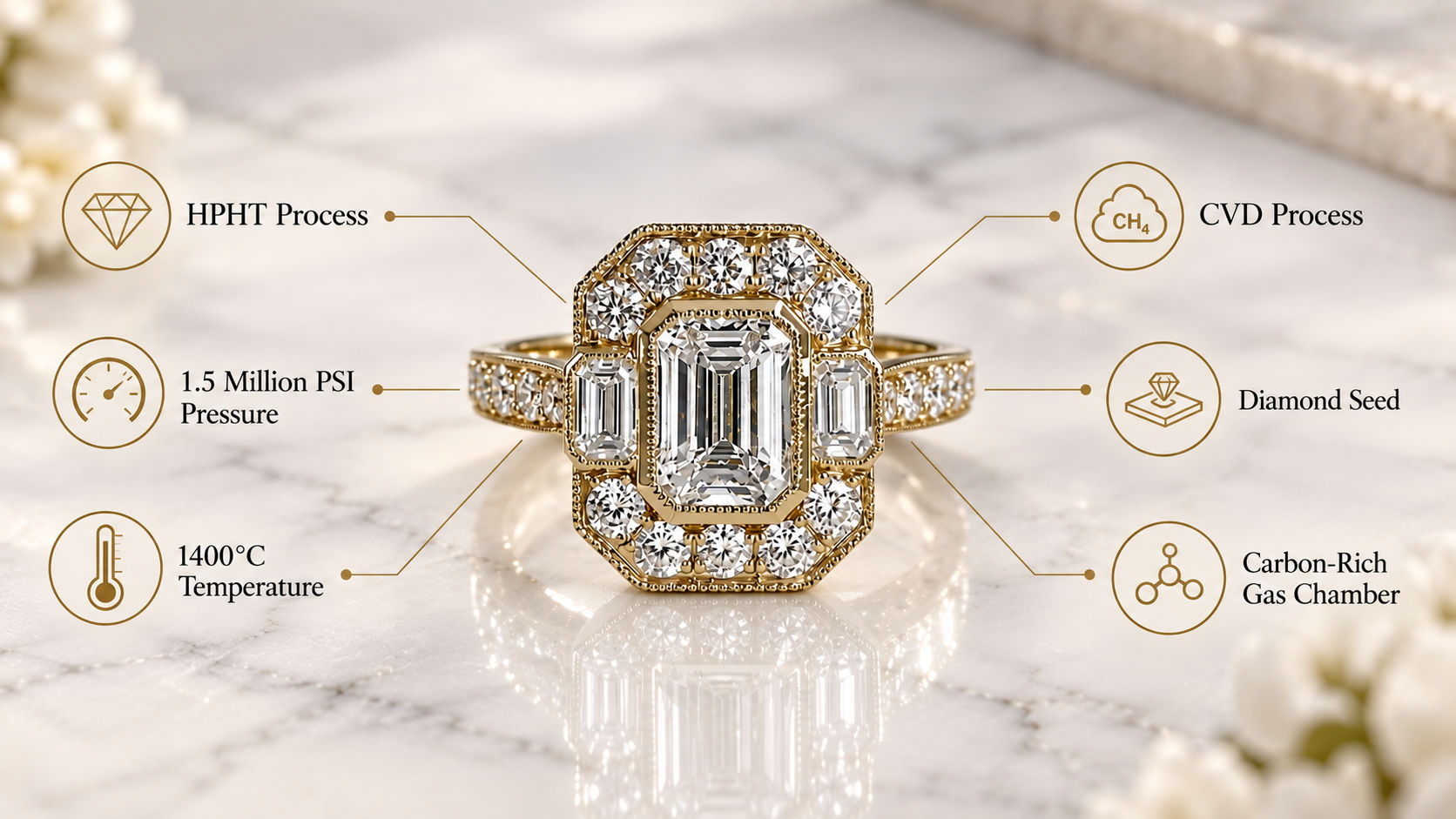
Two methods are used to make lab grown diamond engagement rings. They feel almost opposite when you look at how they work. The first method is HPHT. It stands for high pressure, high temperature. For HPHT, a carbon source goes into a sealed chamber. The setup is pushed to extreme pressure, about 1.5 million psi. At the same time, heat is raised past 1,400°C. The goal is to mimic the way natural diamonds form. This method usually takes weeks. It creates a diamond crystal. It has also been used in business for a long time. In the 1950s, General Electric made gem-grade stones with this approach.
The second process is CVD: Chemical Vapour Deposition. A thin diamond seed, often a slice of an existing diamond, is placed in a chamber filled with carbon-rich gases. Microwaves ionise the gases, breaking them apart and allowing carbon atoms to attach to the seed and build up layer by layer into a full diamond. Lab grown diamond engagement ring stones grown by CVD take six to ten weeks for a one-carat stone. The result is a diamond that grows from the outside in, which is the opposite of how a natural diamond forms and which allows for remarkable control over the final stone's properties.
Lab Grown Diamond Rings: What the Certificate Actually Tells You
Lab grown diamond rings should come with a grading report. Ideally, the report is issued by IGI or GIA. These organisations also grade natural and mined diamonds. That means the standards are not low or made up for labs. The report follows the same four C categories: cut, colour, clarity, and carat. If the lab diamond shows colour D and clarity VS1, the certificate wording should line up with what you would expect on a mined diamond with those same grades.
If you are a lab grown diamond ring buyer, this matters simply. The report spells out what the stone is, and the grader has nothing to gain from the deal. It is also becoming clear that lab stones often get better clarity marks for the same money, or for less. The reason is the way they are made. The growth process is tightly controlled, so you usually see fewer internal marks than you would in diamonds formed in nature. A lab diamond labelled VS1 is not a fallback. It matches the grading on the paper.
2 Carat Lab Grown Diamond: The Size Shift That Changes Everything
The "value" angle for lab grown diamonds has a detail people often skip. Looking only at the price misses a bigger shift. In many cases, that same budget takes you one full carat higher. So money that would normally buy a one-carat mined stone can often get you a two-carat lab stone instead. This is not a small bump. A one-carat and a two-carat diamond look different in real life. The two-carat stone shows more area when you view it from the front. It also gives a stronger look on the hand. If the size is not there, no smart setting can fix that.
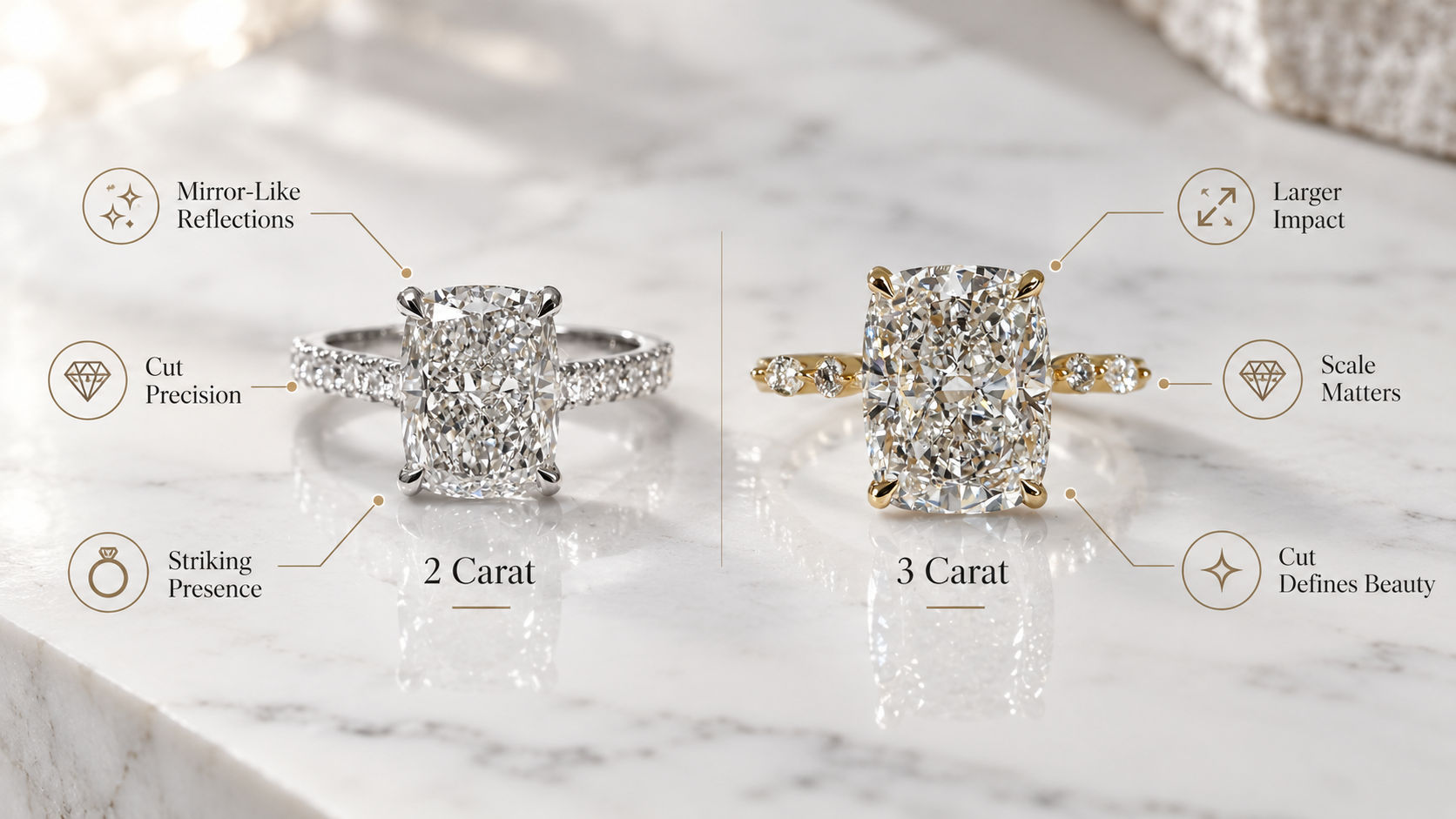
A 2 carat lab grown diamond in the emerald cut is one of the most striking demonstrations of this principle. The emerald cut's broad, open table at two carats creates mirror-like reflections that span the full face of the stone, a quality that becomes genuinely hypnotic at this size. At Layla Diamonds, this is the configuration we show clients who come in sceptical about lab grown stones. The stone makes the case far more effectively than any explanation.
Money that would normally buy a one-carat mined stone can often get you a 2 carat lab grown diamond instead. A one-carat and a two-carat diamond look different in real life; if the size is not there, no smart setting can fix that.
3 Carat Lab Grown Diamond: When the Stone Enters a Different Category
Three carats is the threshold at which lab grown diamonds enter a different conversation entirely. A 3 carat lab grown diamond is not a ring that asks to be noticed; it simply is noticed. The scale of the stone at this weight, the way it spans the finger, and the intensity of its light performance in any setting, all of it operates at a level that smaller stones, however beautiful, cannot match. In a mined diamond, three carats represents a significant financial commitment. In lab grown form, it sits within reach of budgets that would have otherwise stopped at one.
At Layla Diamonds, a 3 carat lab grown diamond begins with the certificate and moves to an in-person assessment because at this size, the quality of the cut determines everything. A well-cut three-carat lab grown oval or round brilliant will outperform a poorly cut mined stone twice its price. The origin of the diamond does not determine its quality. The cut, the clarity, and the care with which it was grown and graded do.
Lab Grown Engagement Ring: The Fact That Surprises People Most
A lot of people are shocked the first time they pick up a well made lab grown engagement ring. They look at it and feel it, and still they cannot spot anything off. You cannot point to it in a mirror. You cannot catch it by touch. Even under a loupe, it does not give much away at first glance. Most gemologists also do not rely on eyesight alone. They use special tools that are made to check tiny growth details. They also look at trace element data. That is how they tell a lab grown stone apart from a mined one. In the end, a lab grown engagement ring just seems like a diamond ring, because that is what it is.
The question that follows, if no one can tell, does the origin matter? is one that different people answer differently. Some find the origin irrelevant. Others find it an advantage: a stone whose production they know more about, whose journey they can trace more clearly. At Layla Diamonds, we do not advocate for either position. We show clients both options and let the stones speak for themselves.
Lab Grown Diamonds Jewellery: Beyond the Engagement Ring
The value advantage of lab grown diamonds extends beyond the engagement ring into every category of fine jewellery. Lab grown diamonds jewellery: eternity bands, pendant necklaces, earrings, and bracelets, becomes achievable at price points that mined diamond equivalents would put significantly out of reach. An eternity band set with lab grown diamonds, a significant diamond pendant necklace, and matched diamond stud earrings, all of these move from aspirational to accessible when the stones are lab grown.
At Layla Diamonds, we approach lab grown diamonds jewellery with the same standard of stone selection and craftsmanship as any mined diamond piece. The setting quality, the metalwork, the finish, none of these change with the origin of the stone. What changes is what a given budget can achieve across a complete jewellery collection. For many clients, that is the most compelling argument of all.
The Most Important Thing to Know
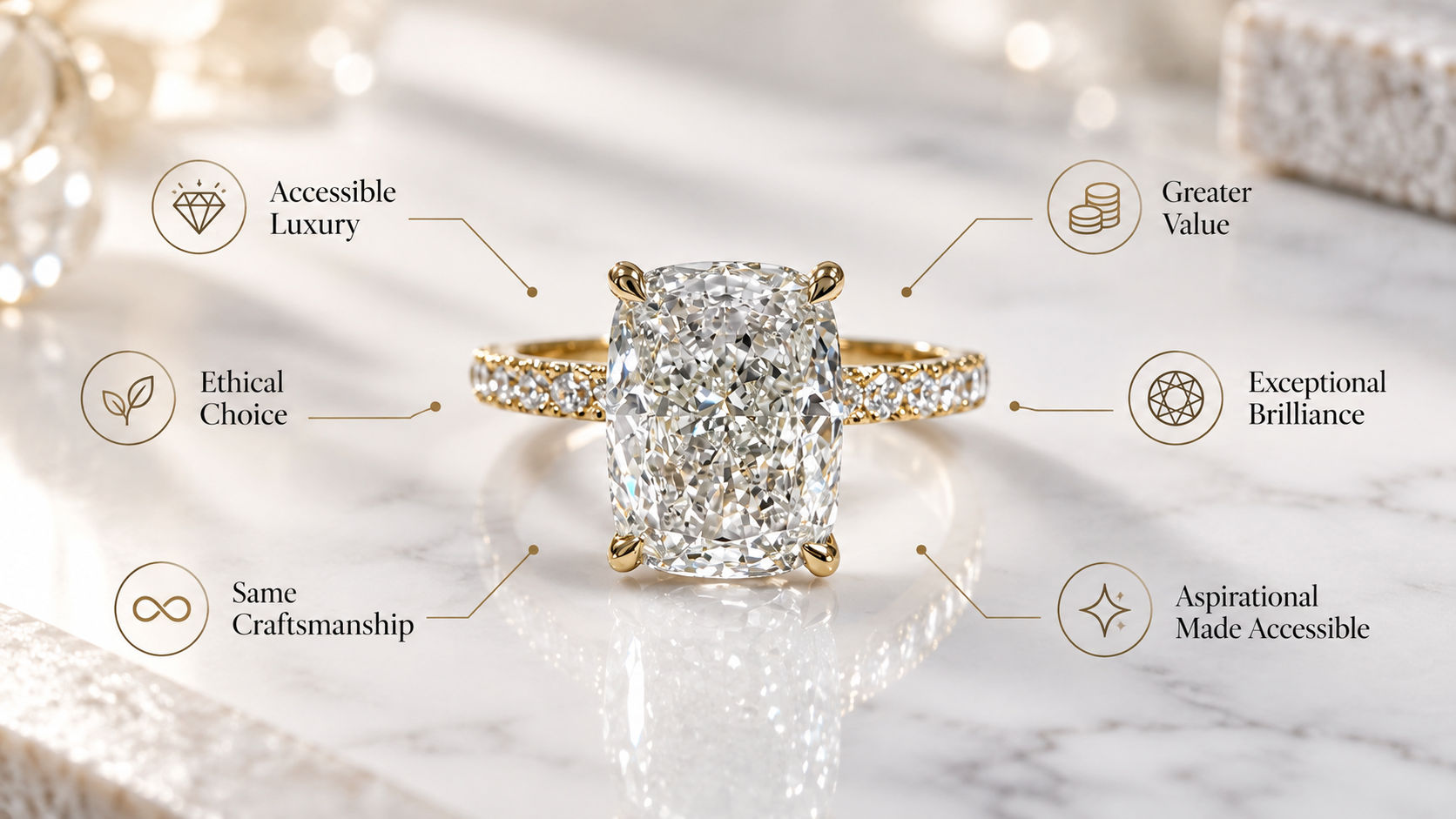
Lab grown diamonds are real diamonds. Plain and simple. No fancy labels. They are not meant to replace diamonds. They are diamonds. Made the same way at the level of the crystal. The carbon structure matches. The hardness matches too. The refractive index is the same. You still see the fire and the sparkle you expect. Even how they change over a long lifetime lines up. The look stays aligned with what natural diamonds do. So the main gap is where the crystal grows. That is it.
Lab grown diamonds are graded by the same labs that grade mined stones. They can be set in similar metals and used in the same ring styles. People wear them on the same hands as well. So the decision is mostly about where the diamond comes from and what it costs. It is not really about quality. At Layla Diamonds, you can choose either type. We look at them closely and help you pick one that fits. Anyone who comes in can see the options in person. The key thing is to match the diamond to the person who will wear it.
What You Should Know Before You Decide
- Lab grown diamond engagement rings are made by two completely different processes. HPHT mimics the earth's mantle at 1.5 million psi and 1,400°C; CVD builds a diamond atom by atom from a seed over six to ten weeks; both produce real diamonds.
- Lab grown diamond rings should come with an IGI or GIA grading report. The same four C standards as mined stones, the growth process is tightly controlled, so lab stones often reach better clarity grades for the same money or less.
- A 2 carat lab grown diamond is often achievable on a one-carat mined budget. A one-carat and a two-carat diamond look different in real life; the two-carat shows more face-up area and a stronger look on the hand that no smart setting can replicate at a smaller size.
- A 3 carat lab grown diamond enters a different category entirely. At this size a well-cut lab grown oval or round brilliant will outperform a poorly-cut mined stone twice its price; cut, clarity, and grading care determine quality, not origin.
- A lab grown engagement ring surprises most people in person. Not visible by eye, by touch, or under a loupe; even trained gemologists need specialist equipment to distinguish origin, because the stone is a diamond in every physical and optical sense.
- Lab grown diamonds jewellery makes a complete collection achievable. Eternity bands, pendants, earrings, and bracelets all move from aspirational to accessible; the setting quality, metalwork, and finish stay the same regardless of where the stone was grown.
Come and See What Lab Grown Diamonds Look Like
At Layla Diamonds, our lab grown diamonds collection is selected to the same standard as everything we do. Book a private consultation at our London store and see the difference for yourself.

.webp)

Comments
Post a Comment